Friday, June 19, 2009

Researchers Testing “One-Two Punch” Against Disease-Spreading Thrips


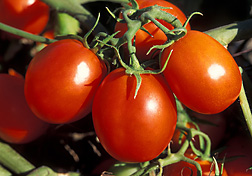
"Spraying tomatoes with kaolin, a type of powdered clay, and one of three plant essential oils cut in half the incidence of tomato spotted wilt disease, which is spread by thrips.


According to Stuart Reitz, an entomologist with the ARS Insect Behavior and Biocontrol Research Unit’s Tallahassee, Fla., site, kaolin forms a white coat that may interfere with thrips’ ability to zero in on color cues during flight. Thrips that do still land on treated plants may find the kaolin coat difficult to penetrate with their juice-sucking mouthparts. This, in turn, may diminish their transmission of the TSW virus, which is present in the insects’ saliva. " Jan Suszkiw


Source: USDA (ARS) http://www.ars.usda.gov/

It Pays to Furrow Dike


"Furrow diking not only saves water, but reduces irrigation costs to a point where it makes economic sense, according to Agricultural Research Service (ARS) scientists.

Furrow diking is a tillage system where soils are plowed into ridge-like barriers running alongside row crops. The ridges hold irrigation and rain water, allowing it to soak into the soil instead of washing away." Dennis O'Brien

More »

Source: USDA (ARS) http://www.ars.usda.gov/

Wednesday, May 20, 2009

Watermelons Tapped for Ethanol


"Agricultural Research Service (ARS) studies in Lane, Okla., have shown that simple sugars in watermelon juice can be made into ethanol. In 2007, growers harvested four billion pounds of watermelon for fresh and cut-fruit markets. Around 800 million pounds--or 20 percent of the total--were left in fields because of external blemishes or deformities.

Now, instead of being plowed under, such melons could get an economic "new lease on life" as ethanol. Normally, this biofuel is produced from cane crops like corn, sorghum or sugarcane as a cleaner-burning alternative to gasoline. The watermelon work reflects a national push by ARS to diversify America's "portfolio" of biofuel crops that can diminish the reliance on petroleum, especially from foreign suppliers." Jan Suszkiw (ARS)

More »

Source: USDA Agricultural Research Service (ARS)

Monday, May 18, 2009

Study Finds Sugar Beet Varieties React Equally to Nitrogen Applications


"A study conducted by Agricultural Research Service (ARS) scientists and their cooperators has dispelled a belief among some sugar beet growers that different sugar beet varieties require different nitrogen fertilization applications.

In integrated farming systems, sugar beet growers harvest the root for cash income and use the tops and root-processing byproducts for livestock feed. This dual benefit works well, but the amount of nitrogen fertilizer required to produce more tops decreases the amount of sugar in the root."

More »

Source:USDA Agricultural Research Service (ARS)

Tuesday, May 5, 2009

Agriculture deputy secretary Merrigan announces funding for new organics initiative


"WASHINGTON, May 5, 2009— Speaking today to the USDA National Organic Standards Board (NOSB), Agriculture Deputy Secretary Kathleen Merrigan announced $50 Million for a new initiative to meet the Obama Administration's promise to encourage more organic agriculture production. Funding for the initiative is being made available as part of the Environmental Quality Incentives Program (EQIP)"
More »

Source: www.usda.gov
Release No. 0146.09

Thursday, April 30, 2009

A Biocontrol for a Wide-Ranging Thrips


"A pest with a voracious appetite may have met its match in a predatory mite being evaluated as a biocontrol agent by Agricultural Research Service (ARS) scientists in Fort Pierce, Fla. in collaboration with University of Florida researchers.

The chilli thrips is an invasive pest that feeds on leaves, turns them brown, kills new growth and attacks up to 150 crops, including peppers, strawberries, tomatoes, peanuts, cotton and a variety of ornamentals."

More »

Source: USDA Agricultural research service

Why Invasive Plants Take Over


"New research shows that two key causes of plant invasion--escape from natural enemies, and increases in plant resources--act in concert. This result helps to explain the dramatic invasions by exotic plants occurring worldwide. It also indicates that global change is likely to exacerbate invasion by exotic plants."
More »

Source: USDA Agricultural research service