Monday, February 8, 2010

$2 Billion Spent a Year On the Medfly Now Falling On the California Farmer

With all of the issues currently happening for the California farmer, news like this isn’t very welcome. The Mediterranean fruit fly (below) has infested the state of California since September 2009 and now is quite an issue on the Board of California Agriculture.

Board officials are estimating that a yearly cost to control the Medfly is ranging around the $2 billion mark. The Medfly, destroys crops and creates a large issue for California farmers. With anywhere between 60 to 70 day pesticide treatment periods, that are required by law, if a crop is found to be infected causes quite a problem. Certain crops are able to survive for this quarantined period and crop loss almost seems imminent.

The executive director of the San Diego Farm Bureau, Eric Larson has stated that the core area farms will experience sever financial losses. With the Medfly creating large farm management issues, Larson agrees that something serious must be done to stop the Medfly from inhabiting the fears of California farmers.

With a 79 sq-mile quarantine increasing to 148 sq-miles in less than a month, Escondido is nearly covered. It has not been established as to how many farmers have been or are going to be affected but the big question is, who is going to foot the bill? With the state’s deficit larger than ever, $2 billion is a big bill to swallow and Larson fears that the farmer will end up paying for it. With over 260 fruits and veggies being restricted from moving and the Medfly being able to cover over 4.5 miles over their life expectancy, the issue is serious and could cost the nation over $280 million in crop loss.

With one farm reporting losses over $14,000 in 2009, the question still remains the same, when will the Mediterranean fruit fly haunt our dreams no more?

California Agriculture Fights Back Against the Nipomo Apple Moth

Residents in the Nipomo Mesa area are being contacted with some rather interesting and annoying news. Recently, the California Department of Food and Agriculture has announced that is planning a stealthy, safe approach to eliminating a new threat to the Nipomo area.

What’s known as The Light Brown Apple Moth was found in two places earlier this month, once near the Blacklake Golf Courses, and also again around Cypress Ridge. Below, a picture of this invasive species shows how the specie feeds on different plant species, 123 plants to be exact.


Most agricultural followers may remember the discover of the apple moth arising in California in 2007. This time, the California Department of Food and Agriculture plan to place twist ties that secrete a female moth pheromone that will disorient the apple moth and not allow it to find mates, thus eliminating the breeding rate, according to one Rich Little, Deputy County Agriculture Commissioner.

These Apple Moths are originally from Australia, and while can be a problem is uncontrolled, Little believes that establishing a plan of action will greatly reduce the danger that this little moth could impose on an already suffering agriculture in California. Nipomo Mesa residents should not worry about the pheromone release as will not affect humans, except for specific individuals with certain allergy conditions says Little.

For more information you may go to www.cdfa.ca.gov//lbam.

Friday, February 5, 2010

AG VISION TASKFORCE: LOOKING INTO THE FUTURE

When we look into the future of the California agriculture, it gets a bit stressful. Most do not want to think about what lies ahead for the California grower. Thankfully, there is a group that is stepping up to the plate.

The Ag Vision Taskforce, which is an informal gathering of some of the best representatives of California’s agricultural issues, has received a very welcomed financial gift from the California Department of Food and Agriculture. Having been around for the past two years, this group is staying focused despite the obstacles that lie ahead, such as the state’s water shortages, the threat of insect populations, and of course, the ever declining economy.

Karen Ross, former CEO of the California Association of Winegrape Growers is by far the individual who is taking charge of this movement and should be the one receiving most of the credit. Ross, who was recently appointed Senior Advisor to Agriculture Secretary Tom Vilsack has continuously provided hours upon days of suggestions and advice to help mold a prosperous future for the California Agricultural Future.

If you want to learn more about the steps being taken to create a healthier planet and increase the health and wellness of California agriculture, visit the website http://www.cdfa.ca.gov/ag.

Thursday, November 12, 2009

New UC Web site helps farmers with business and marketing


"University of California Cooperative Extension has launched a new Web site at http://ucce.ucdavis.edu/farmbusinessandmarketplace to help new and established small- to medium-scale farmers of fresh products with the business and marketing aspects of their operations.

The Web site is designed for people who are considering farming, and those who have been in the business for quite a while and wish to refresh or enhance their skills. It was designed with Central Coast farmers in mind, but is applicable in most parts of the state. The site aggregates information from the University of California and other universities and agricultural affiliates from around the nation"
More »

Source: University of California Agriculture and Natural Resources
http://news.ucanr.org/newsstorymain.cfm?story=1250

Looking for effective advance fertilizers, plant nutrients and soil amendments? Please visit our website at www.ferticell.com or call (602)233-2223.

Spying on Corn Rootworm Predators’ Nightlife


“Agricultural Research Service (ARS) entomologist Jonathan G. Lundgren, while exploring corn fields at night, has found a very different group of predators than the ones that feed during the day. It turns out that these night-time predators have a great appetite for corn rootworms, the most costly pest of corn in the world.
Research on day-active and night-active predatory insects is important for scientists who are developing strategies that maximize the potential of the natural predators in crop pest control.
During his night studies, Lundgren focuses on the top few inches of the soil surface, where rootworm larvae do most of their damage to corn roots. Lundgren works at the ARS North Central Agricultural Research Laboratory in Brookings, S.D.
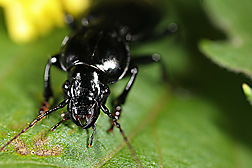
Lundgren found that one common carabid beetle, Poecilus chalcites, prefers day work, while another common carabid, Cyclotrachelus alternans, works a night shift, from 10 p.m. to 3 a.m. Wolf spiders search for rootworms during the night, while some other spiders hunt during the day.”

More »

Article By Don Comis (ARS)

Source: USDA (ARS) http://www.ars.usda.gov

Looking for effective advance fertilizers, plant nutrients and soil amendments? Please visit our website at www.ferticell.com or call (602)233-2223.

Tuesday, September 15, 2009

Aerial Imagery System Helps Save Water


"Agricultural Research Service (ARS) scientists are developing a system that saves water by using aerial imagery and ground-based sensors to determine the irrigation needs of small sections of cultivated fields.

Conventional irrigation practices, even when based on modern management and water application techniques, can be wasteful because they assume crop water needs are the same throughout an entire field, according to Douglas Hunsaker, an agricultural engineer at the ARS Arid-Land Agricultural Research Center in Maricopa, Ariz. It also is extremely difficult to go into a large field and visually observe and quantify different water needs for specific areas.

Farmers are beginning to use remote sensing technology to monitor crop growth, fertilizer needs and field conditions. Hunsaker's goal is to combine one remote sensing aerial image of a field with a system of wireless sensors tied to computer software that will accurately determine the irrigation needs of small areas on a daily basis throughout the season.

Ideally, farmers could identify areas with high or low water needs with data transmitted to their computers and, using either a drip or a sprinkler system, adjust irrigation levels based on the data. The technology could be particularly useful in the parched Southwestern United States, where conserving water is a major priority."

By Dennis O'Brien (ARS)


More »


Source: USDA (ARS) http://www.ars.usda.gov


Looking for effective fertilizers or plant nutrients?, please visit our website at www.ferticell.com or call (602)233-2223.

Thursday, September 10, 2009

Food "Tattoos" an Alternative to Labels for Identifying Fruit


"Those small and sometimes inconvenient sticky labels on produce may eventually be replaced by laser “tattoo” technology now being tested by Agricultural Research Service (ARS) and University of Florida (UFL) scientists.

Called laser etching, the new technology puts a tattoo on grapefruit and other produce so it can be identified at the supermarket checkout lines. The technology was invented by former UFL scientist Greg Drouillard, now with Sunkist Growers. Grapefruit has always been labeled with sticky paper labels that mar the fruit and stick to one another in storage. The labels are also easily removed, making it more difficult to track a piece of produce back to the source if the need arises.

Microbiologist Jan Narciso at the ARS Citrus and Subtropical Products Laboratory in Winter Haven, Fla., and UFL researcher Ed Etxeberria investigated laser technology as an alternative to sticky paper labels.

A carbon dioxide laser beam was used to etch information into the first few outer cells of the fruit peel. The mark can’t be peeled off, washed off or changed, offering a way to trace the fruit back to its original source. This permanent etching into the fruit peel does not increase water loss or the entrance of food pathogens or postharvest pathogens if the laser label is covered with wax"

By Sharon Durham, (ARS)

Source: USDA (ARS) http://www.ars.usda.gov

Looking for effective fertilizers or plant nutrients, please visit our website at www.ferticell.com or call (602)233-2223.